
Core Drilling on the Gold Coast
Round penetrations through concrete, block or brick for pipes, ducts, conduit, drainage and fixings — drilled to a set diameter rather than cut to a line.
Have the hole count, diameter, depth, orientation and which side is accessible.
- Diameter and depth drive the job
- Pipes and cables: info comes from you
- Scope confirmed on site
- Count
- How many holes
- Diameter
- Or what passes through
- Depth
- Or element thickness
- Orientation
- Down, across or overhead
When core drilling is the right pathway
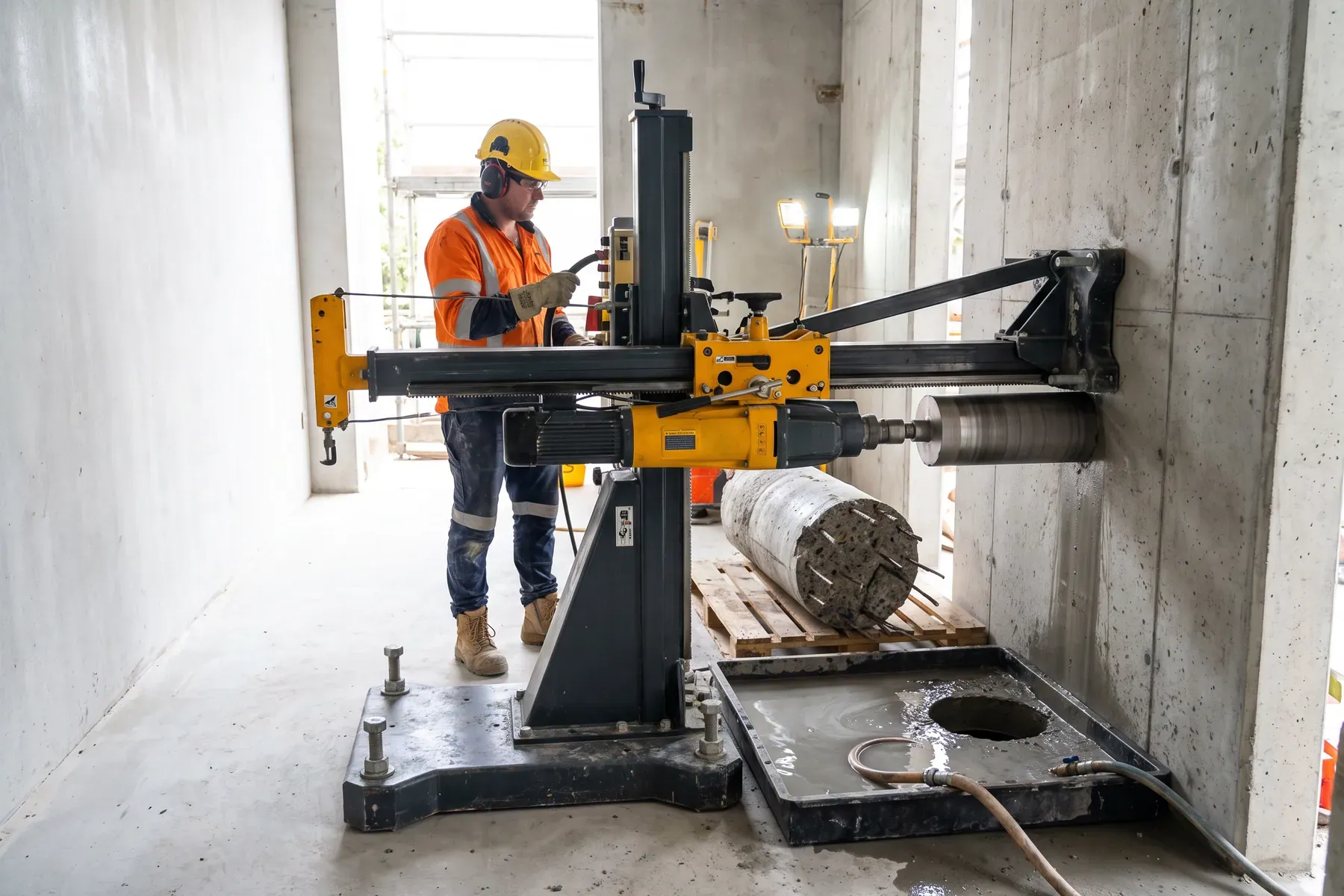
If the finished opening is round and its diameter matters, it is a drilling job. A rig is anchored to the element, a hollow diamond barrel cuts a cylinder out of it, and the extracted core is removed whole. That is a different operation from sawing, where a blade cuts a line and a section is separated from the surrounding slab.
The practical consequence is that a cored hole is clean, sized and repeatable, which is why penetrations for plumbing, hydraulics, mechanical services, electrical and drainage are almost always drilled rather than cut. Where an opening is rectangular but small, corner holes are often drilled first so a saw has somewhere to finish into.
The hole specification to bring to the call
Core drilling is described by geometry rather than by area. These are the details that decide the setup, and most of them can be answered by standing in the room and looking.
- How many holes
- One penetration and twenty penetrations are different jobs even at the same diameter. A rough count is enough.
- Diameter of each hole
- Usually set by what passes through — a pipe, a duct, a conduit or a fixing. If the product size is known, that is the better number to give.
- Depth, or the thickness of the element
- A hole through a 150 mm slab and a hole through a 400 mm wall behave very differently. If the thickness is unknown, say so.
- Orientation
- Down through a floor, horizontally through a wall, or upwards into a soffit. Overhead work changes setup, water management and access entirely.
- Material
- Reinforced concrete, plain concrete, blockwork or brick. Reinforcement is expected in structural elements and is not itself a problem to describe.
- Which side is accessible
- A rig is anchored to one face and needs clear working room there. The far side matters too, because the core has to break out somewhere.
- What is behind or below
- Occupied rooms, live services, ceilings, or another tenancy. This is the detail most often left out and most likely to change the job.
- Water and slurry
- Most core drilling is wet. Whether a tap is nearby, and where water must not be allowed to run, is worth confirming.
- Services information
- Whether anything is known to run through the area, and whether it has been marked or scanned by someone engaged for that purpose.
Orientation and access change the setup
Downwards through a floor
The most straightforward setup. The main questions are what sits directly below, whether water can be controlled at both levels, and where the core lands when it releases.
Horizontally through a wall
The rig anchors to the face, so that face needs clear working room. The far side needs protection and access, because the core has to break out and be recovered.
Upwards into a soffit
Overhead drilling changes water management, support and the working platform. It is the orientation most worth flagging early, because it can change what is practical.
Restricted or occupied areas
Plant rooms, risers, ceiling spaces and tenanted areas often limit setup room and working hours more than the hole itself does.
What changes the job on site
Diameter and depth set the shape of the work. These conditions decide whether it is straightforward.
| What to check | Why it matters | Who supplies or confirms it | What to mention on the call |
|---|---|---|---|
| Concrete element and orientation | A slab, a wall, a beam and a suspended floor are different jobs even at the same dimensions. | You, from what is visible on site | What is being cut, and whether the surface is horizontal, vertical or overhead. |
| Approximate dimensions and depth | Lineal metres, hole diameter and cut depth are the first things that change the method and the time on site. | You, measured or paced out | Length or hole count, plus the thickness of the concrete if it is known. |
| Reinforcement | Mesh, bar and post-tensioned strand change how a cut is made and what has to be confirmed before it starts. | Drawings, the builder, or an engineer | Whether the element is reinforced, and whether any drawings exist. |
| Known services in or near the cut | Water, power, gas, comms, hydraulic and drainage lines have to be identified before a blade or bit goes in. | The site owner, builder or a service locator | What is known to run through the area, and whether anything has been marked or scanned. |
| Access and staging | Doorway widths, stairs, lifts, ramps and parking decide which equipment can physically reach the work. | You or the site contact | How equipment gets from the street to the work area, and where it can be set down. |
| Water supply and slurry control | Most diamond cutting is wet. Water has to get in and slurry has to be contained and removed. | You or the site contact | Whether there is a tap nearby, and where water may and may not run. |
| Dust and silica control | Cutting and drilling concrete releases respirable crystalline silica, which is a regulated exposure in Queensland. Wet suppression or on-tool extraction is standard, and enclosed areas need more. | The party performing the work, as part of its own job assessment | Whether the area is enclosed or occupied, and whether extraction or containment is required by the site. |
| Structural approval status | Cutting a structural element can require design, temporary support and sign-off before work is planned. | A structural engineer or the responsible builder | Whether an engineer has specified the opening, and whether support is already designed. |
| Follow-on trades | Making good, sealing, fire-stopping and the trades that use the opening are separate scopes. | You or your builder | What happens to the opening after it is cut, and who is arranging that work. |
Limits worth knowing before you call
What is not part of this
Locating services, concrete scanning, structural approval, fire-stopping, plumbing and electrical connections, hazardous-material handling and making good the opening are separate scopes and are not offered here. Nothing on this page determines whether an element is safe to penetrate.
Information about what runs through an area has to come from the site — drawings, the builder, existing marking, or a locating specialist engaged for that purpose. Where an element is structural, the decision to put a hole through it belongs to an appropriately qualified engineer, not to a cutting contractor and not to this page.
Hole count, diameter, depth, orientation, material, accessible side, and anything known about services.
Ready the hole details before you call
Nothing here is submitted or stored. Run through it so the first call covers what actually decides the job.
The job
- What is being cut — slab, wall, footing, path, block or brick
- What the finished opening has to be — a straight cut, a rectangular opening or a round hole
- Cut length in metres, or the number of holes and the diameter of each
- Cut depth, or the thickness of the concrete if it is known
- Whether the element is reinforced, and whether drawings exist
The site
- Suburb and postcode
- Property or site type — house, unit, commercial tenancy, managed building or active construction site
- Where the work sits within the property
- Whether the area is occupied while the work happens
- Any restriction on work hours
Access and services
- How equipment gets from the street to the work area
- Narrowest doorway, gate, path or lift on that route
- Where equipment can be set down and staged
- Whether a water tap and power are available nearby
- Any known services in or near the cut, and whether they have been marked
Responsibility and timing
- Whether a structural engineer has specified the opening or any support
- Who removes the cut section once it is free
- The site contact who can authorise the work and open the area
- Whether photographs of the area are available
- Preferred timing, described as a preference rather than a fixed date
Core drilling specifics
- Number of holes and the diameter of each
- Depth of each hole, or the thickness of the element
- Whether holes run down, horizontally or upwards
- Which face the rig can be anchored to
- What sits behind or below the exit point
This checklist is information for your own use. It is not a form and nothing typed near it is collected by this website.
Core drilling questions
Do I need concrete cutting or core drilling?
It depends on the shape of the opening. A round hole for a pipe, duct or cable is a core-drilling job; a straight cut, a rectangular opening or a section being removed is a sawing job.
Plenty of jobs need both — for example a rectangular opening that starts with corner holes. Describing the finished result rather than the equipment is the fastest way to sort it out on the call.
What information affects the price?
The measurable scope: how much is being cut, how deep, through what material, how the equipment reaches the work, and how water, slurry and the cut section are managed.
Setup and access often matter as much as the cut itself. A short cut in a difficult position can involve more work than a longer cut in an open area.
How is concrete dust controlled?
Cutting and drilling concrete can release respirable crystalline silica, which is why water suppression or on-tool extraction is used and why exposure is a regulated matter in Queensland.
The controls that apply to a specific job are decided by the party performing the work as part of its own job-specific risk assessment, not by a website.
Will you find the pipes and cables before cutting?
No — locating buried or embedded services is a separate specialist activity and is not offered here.
Information about services in or near the cut has to come from the site: drawings, the builder, existing marking, or a service locator engaged for that purpose. This applies to scanning as well, which is not part of the scope here.
Still deciding between a hole and a cut? Compare the two by opening shape, or go back to the method comparison.
Sources used on this page
- Respirable crystalline silica in construction — WorkSafe Queensland (opens in a new tab)
Silica exposure controls when concrete is cut or drilled.
Describe the penetration
Hole count, diameter, depth and orientation are usually enough to establish whether the job is one to take further and what the next step would be.
Count, diameter, depth, orientation and access.