
Concrete Cutting in Surfers Paradise
Cuts and penetrations in occupied high-density buildings, where the work has to be contained and fitted around everyone else using the building.
Have the building contact, the loading and lift arrangements, the approved hours, and the cut details.
- Building approval comes first
- Containment planned, not improvised
- Coverage confirmed on the call
- Who approves
- Building or body corporate
- Getting in
- Loading bay and service lift
- When
- Approved working hours
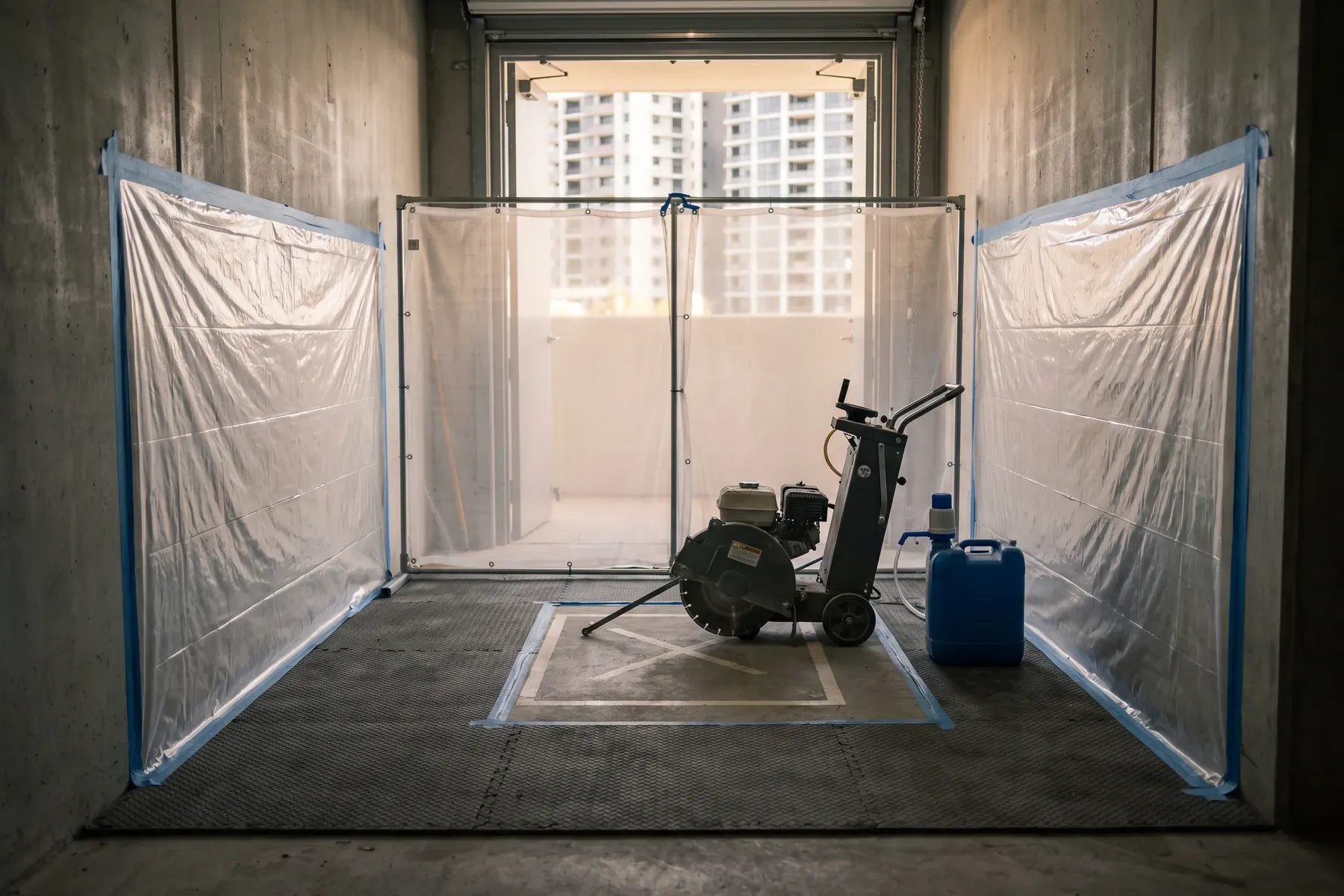
- Containment
- Water, slurry and dust
What makes a Surfers Paradise job different
Surfers Paradise is dense, vertical and busy at almost all hours. Apartments, hotels, short-stay accommodation and ground-level retail sit in the same buildings, which means a concrete job is usually happening while people are living, working or staying a few metres away.
The practical effect is that the cut is scheduled around the building rather than the other way around. Loading bays are booked, service lifts are booked, working hours are set, protection is specified, and the work area is isolated from the parts of the building still in use. That is normal for this kind of building — it just needs to be known before anything is arranged.
Local noise expectations are set out by the City of Gold Coast, and individual buildings frequently impose stricter conditions than those. Neither is something a website can grant an exemption from, and no after-hours or out-of-hours work is offered here.
What building management has to agree first
In a high-density building the constraint is rarely the concrete. It is that a lot of other people are using the building while the work happens, and most of what has to be arranged is arranged by someone other than the person who wants the cut.
| What has to be arranged | Why it applies | When it is settled |
|---|---|---|
| Who approves the work | In an occupied tower this is normally building management or the body corporate, not the resident or tenant asking for the work. | Before anything is scheduled |
| Loading bay booking | Many buildings require a booked loading window with a fixed start and finish time. | Days ahead in some buildings |
| Service lift booking | A goods lift is often the only way equipment reaches the floor, and it is usually booked separately from the loading bay. | Days ahead in some buildings |
| Approved working hours | Noisy work is commonly restricted to set hours. A building can be stricter than the local law, and often is. | Confirm before the call ends |
| Floor and lift protection | Buildings frequently specify protection for lifts, lobbies and corridors on the route to the work area. | Part of the setup, not an extra |
| Notice to neighbours | Adjoining apartments and tenancies are often notified in advance by building management. | Managed by the building |
Keeping the work inside the work area
Water and slurry
Wet cutting produces slurry that cannot be allowed to run into lifts, common areas, drains or a floor below. Containment and removal are planned before the cut, not improvised during it.
Dust
Cutting concrete releases respirable crystalline silica. Wet suppression or on-tool extraction is standard, and the area is separated from everyone not doing the work.
Noise and vibration
In a tower these travel further than most people expect. Approved hours exist for that reason, and they cannot be worked around from a website.
The area itself
The work area is isolated so nobody walks into it, which in an occupied building often means the route in is isolated too.
Where the cut usually is
Bathroom and laundry penetrations
New waste or supply lines through a suspended slab are usually core drilling. What sits directly below the slab is the first question, because it is somebody else's ceiling.
Service risers and plant areas
Penetrations through riser walls and plant-room floors are common. Setup room is usually the binding constraint rather than the hole itself.
Tenancy alterations
New openings in block or concrete walls are wall sawing, and where the wall is structural the design and support questions come first.
Inside an occupied unit
Where no machine can be brought in, the work is normally hand or ring sawing, set up and packed down within the approved window.
Not claimed on this page
No after-hours or out-of-hours work, no tower or high-rise capability claim, no permits, no parking arrangements, no local office or crew, no response time and no guaranteed attendance. No Surfers Paradise project is claimed or depicted.
The most useful thing to establish first
Before the cut is described in detail, it is worth knowing who can actually approve the work and what the building requires. In an occupied tower that single answer determines almost everything else about how the job would run.
Building contact, loading and lift arrangements, approved hours, and what is being cut.
Ready the building details before you call
Nothing here is submitted or stored. Run through it so the first call covers what decides the job.
The job
- What is being cut — slab, wall, footing, path, block or brick
- What the finished opening has to be — a straight cut, a rectangular opening or a round hole
- Cut length in metres, or the number of holes and the diameter of each
- Cut depth, or the thickness of the concrete if it is known
- Whether the element is reinforced, and whether drawings exist
The site
- Suburb and postcode
- Property or site type — house, unit, commercial tenancy, managed building or active construction site
- Where the work sits within the property
- Whether the area is occupied while the work happens
- Any restriction on work hours
Access and services
- How equipment gets from the street to the work area
- Narrowest doorway, gate, path or lift on that route
- Where equipment can be set down and staged
- Whether a water tap and power are available nearby
- Any known services in or near the cut, and whether they have been marked
Responsibility and timing
- Whether a structural engineer has specified the opening or any support
- Who removes the cut section once it is free
- The site contact who can authorise the work and open the area
- Whether photographs of the area are available
- Preferred timing, described as a preference rather than a fixed date
Surfers Paradise building coordination
- Building manager or body corporate contact who can approve the work
- Whether a loading bay and service lift have to be booked
- Approved working hours for noisy work in the building
- Floor, lift and lobby protection the building requires
- What is directly below or behind the cut, and who occupies it
This checklist is information for your own use. It is not a form and nothing typed near it is collected by this website.
Sources used on this page
- Noise nuisance information and local laws — City of Gold Coast (opens in a new tab)
Local noise context. Buildings and sites can impose stricter rules than the local law. - Respirable crystalline silica in construction — WorkSafe Queensland (opens in a new tab)
Silica exposure controls when concrete is cut or drilled.
Describe the building and the cut
Who approves the work, how equipment gets in, when it can happen and what is being cut are usually enough to establish whether the job is one to take further.
Building approval, access, hours, and cut details.