
Concrete Cutting on the Gold Coast
Slabs, walls, footings, paths and penetrations — cut to a marked line or drilled to a set diameter. Describe what has to be opened up and it can be worked out whether the job is one to take further.
Have the suburb, what is being cut, roughly how much, how deep, and how equipment reaches the area.
- No price guessed over the phone
- Scope confirmed on site
- Phone enquiries only
- Say first
- Suburb, and what is being cut
- Then
- Length or hole count, and depth
- Then
- How equipment reaches the work
- Then
- Anything known about services or approvals
Start from the opening you need
The quickest way to describe a concrete job is by the shape of the finished opening and the surface it sits in. Pick the description closest to the work — the final method is confirmed against the actual site conditions, not from this page.
- Circular penetration
Something round has to pass through concrete
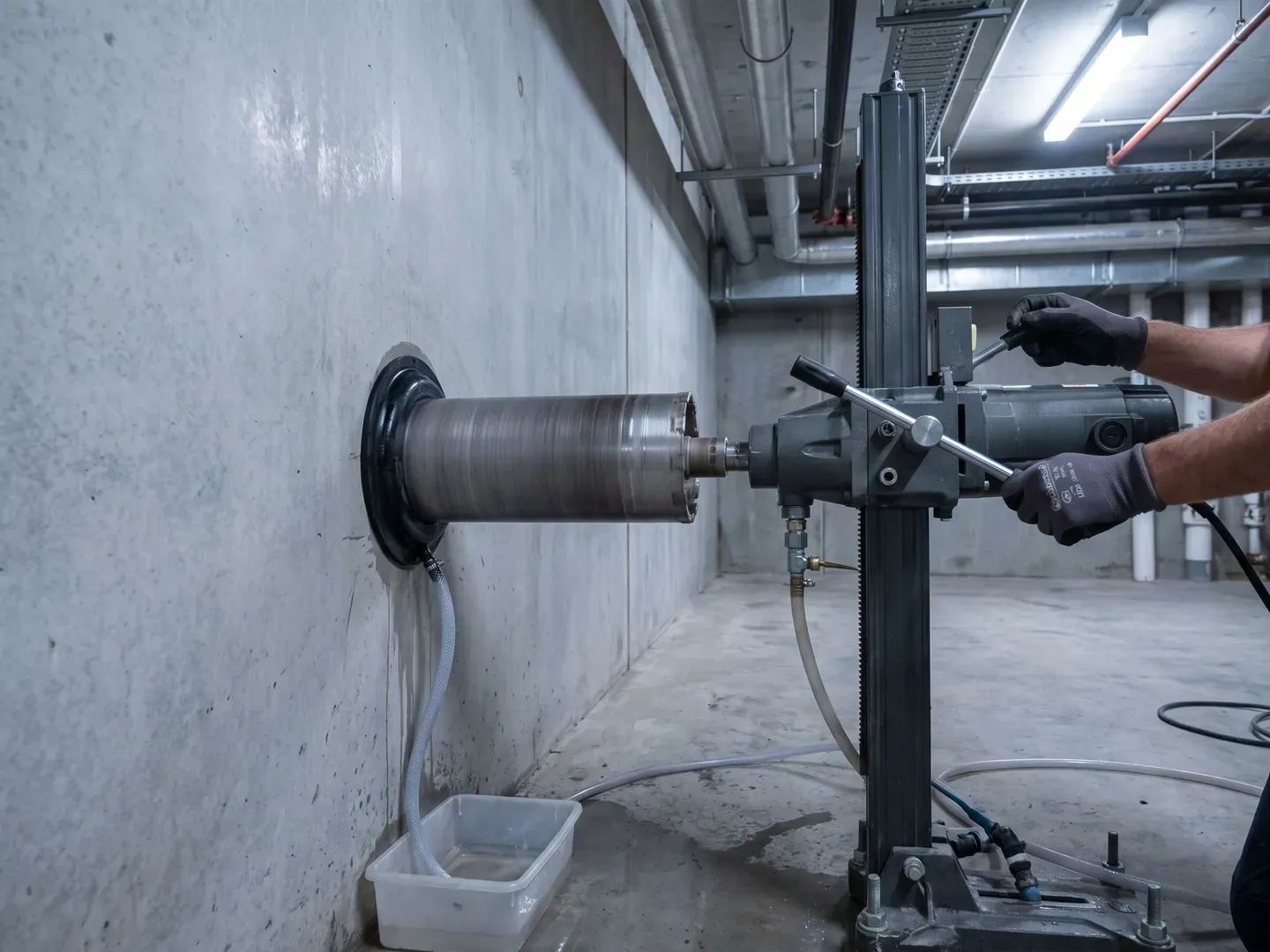
A circular penetration is normally a core-drilling job. The diameter and depth drive everything else.
- Straight line or rectangle
A flat surface has to be cut in straight lines
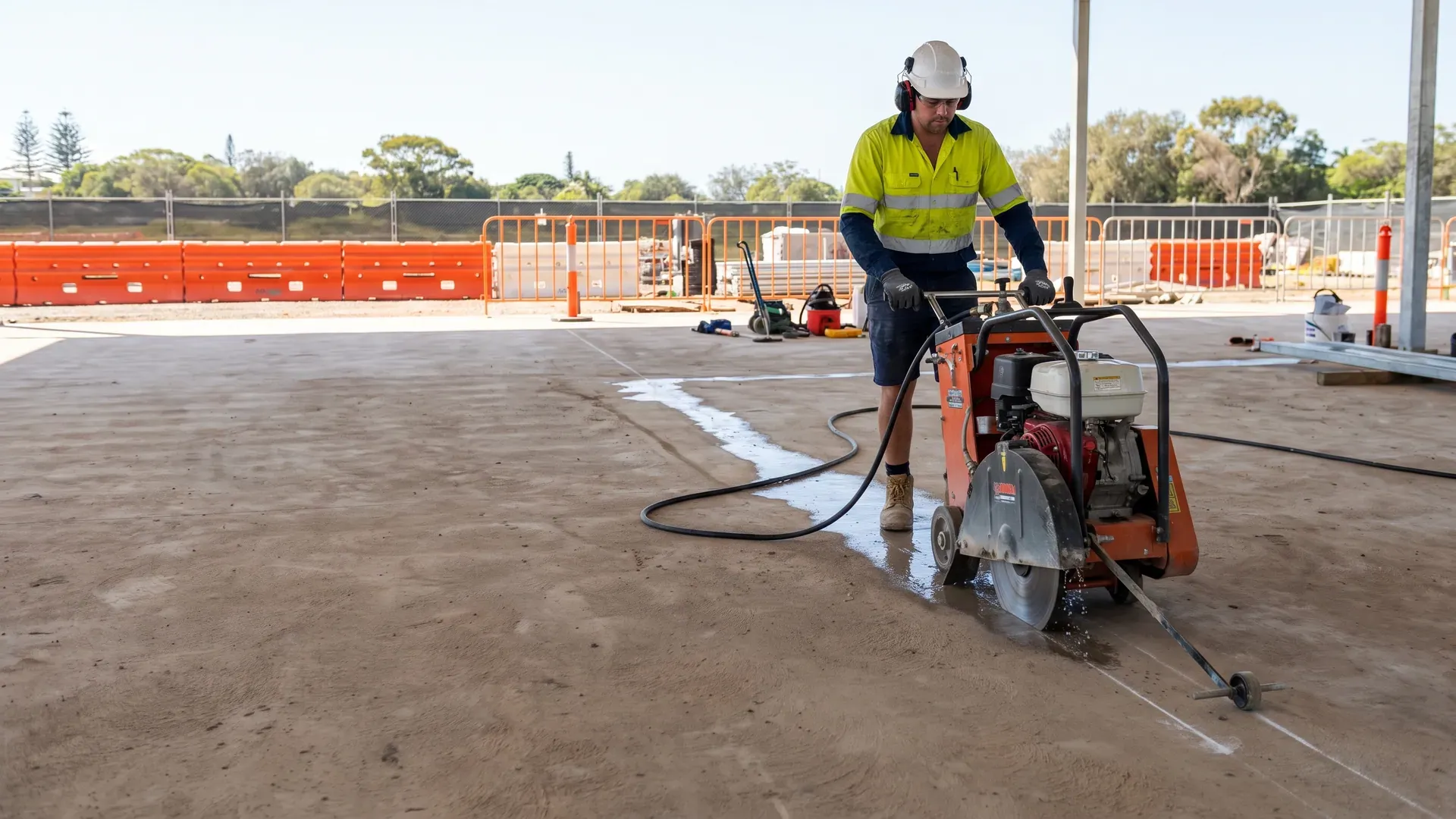
Horizontal cuts in a slab, floor or paved area are normally floor sawing. Lineal metres and depth drive the work.
- Rectangular opening
An opening has to be made in a wall
Vertical and inclined openings are normally wall sawing, and the support and approval questions come first.
- Short cuts and corners
Equipment cannot physically get to the cut
Constrained access, edges and corners are normally handled with handheld or ring-saw methods.
If none of these match, describe the result you need on the call instead of naming a machine. Whether a particular method is offered for a given job is confirmed when the enquiry is reviewed.
Compare the four methods side by side — surface, opening shape, what limits each one and what to measure first.
Cutting and drilling are two different results
Almost every concrete job comes down to one of two outcomes: a line or a rectangle that separates part of the concrete from the rest, or a round hole that lets something pass through it. Sawing produces the first, core drilling the second, and both use diamond tooling on the same material.
Getting that distinction right at the start saves a conversation later, because the measurements that matter are completely different. A saw cut is described in lineal metres and depth; a cored hole is described by diameter, depth and orientation. Jobs that need both are common — a rectangular opening frequently begins with holes drilled at its corners.
Work through the difference with worked examples, or go straight to core drilling or the full method comparison.
What changes the job on site
Five conditions settle most of what a first call needs to establish. Anything unknown is worth saying so rather than guessing — the method pages go through the rest, including water, dust, occupancy and approvals.
| What to check | Why it matters | Who supplies or confirms it | What to mention on the call |
|---|---|---|---|
| Concrete element and orientation | A slab, a wall, a beam and a suspended floor are different jobs even at the same dimensions. | You, from what is visible on site | What is being cut, and whether the surface is horizontal, vertical or overhead. |
| Approximate dimensions and depth | Lineal metres, hole diameter and cut depth are the first things that change the method and the time on site. | You, measured or paced out | Length or hole count, plus the thickness of the concrete if it is known. |
| Reinforcement | Mesh, bar and post-tensioned strand change how a cut is made and what has to be confirmed before it starts. | Drawings, the builder, or an engineer | Whether the element is reinforced, and whether any drawings exist. |
| Known services in or near the cut | Water, power, gas, comms, hydraulic and drainage lines have to be identified before a blade or bit goes in. | The site owner, builder or a service locator | What is known to run through the area, and whether anything has been marked or scanned. |
| Access and staging | Doorway widths, stairs, lifts, ramps and parking decide which equipment can physically reach the work. | You or the site contact | How equipment gets from the street to the work area, and where it can be set down. |
What happens after the call
The call covers the service, the location and the job. From there the enquiry is matched to a local provider who does that kind of work, and they contact you, confirm the scope against the actual site, price it and carry it out. Your agreement for the job is with them, and they invoice you directly.
Providers are screened on their Google rating — 4.5 or above — before they are connected to a job. There is no fee to you for the connection. See the three steps in full.
Describe the concrete element, the cut or opening you need, approximate dimensions, access and any known constraints.
Where enquiries are taken
Enquiries are taken across the Gold Coast. Each area page below covers the access and site questions that come up most often in that kind of location — a suburb page is not a claim of an office, a local crew, availability, or that any particular job can be attended. Coverage for a specific location is confirmed on the call.
- Southport Managed buildings and vertical access
- Surfers Paradise High-density towers and work windows
- Burleigh Heads Tight side access and close neighbours
- Robina Managed sites, inductions and permits
- Nerang Mixed site types and equipment staging
- Coomera Active builds and who authorises the work
Have these ready before the call
Nothing here is submitted or stored. It is a list to run through so the first call covers what actually decides the job.
The job
- What is being cut — slab, wall, footing, path, block or brick
- What the finished opening has to be — a straight cut, a rectangular opening or a round hole
- Cut length in metres, or the number of holes and the diameter of each
- Cut depth, or the thickness of the concrete if it is known
- Whether the element is reinforced, and whether drawings exist
The site
- Suburb and postcode
- Property or site type — house, unit, commercial tenancy, managed building or active construction site
- Where the work sits within the property
- Whether the area is occupied while the work happens
- Any restriction on work hours
Access and services
- How equipment gets from the street to the work area
- Narrowest doorway, gate, path or lift on that route
- Where equipment can be set down and staged
- Whether a water tap and power are available nearby
- Any known services in or near the cut, and whether they have been marked
Responsibility and timing
- Whether a structural engineer has specified the opening or any support
- Who removes the cut section once it is free
- The site contact who can authorise the work and open the area
- Whether photographs of the area are available
- Preferred timing, described as a preference rather than a fixed date
This checklist is information for your own use. It is not a form and nothing typed near it is collected by this website.
Questions that come up before the call
Do I need concrete cutting or core drilling?
It depends on the shape of the opening. A round hole for a pipe, duct or cable is a core-drilling job; a straight cut, a rectangular opening or a section being removed is a sawing job.
Plenty of jobs need both — for example a rectangular opening that starts with corner holes. Describing the finished result rather than the equipment is the fastest way to sort it out on the call.
Is concrete sawing different from concrete cutting?
No — they describe the same work. Concrete sawing is simply the term used for the sawing methods within concrete cutting, and both cover floor, wall and handheld work.
What actually changes the job is the orientation of the surface, the geometry of the opening, the depth and the access.
What information affects the price?
The measurable scope: how much is being cut, how deep, through what material, how the equipment reaches the work, and how water, slurry and the cut section are managed.
Setup and access often matter as much as the cut itself. A short cut in a difficult position can involve more work than a longer cut in an open area.
Does concrete cutting include breaking up and removing the concrete?
No. Cutting separates the concrete; breaking it up, lifting it, carting it away and disposing of it are separate scopes and are not offered here.
Demolition, removal, grinding, scanning, wire sawing, asphalt and road cutting are all outside the scope of this website. Who removes a cut section is worth agreeing before work is arranged.
Does a suburb page mean the job is covered there?
No. A suburb page exists to gather the right details for that kind of site; it is not a statement that a provider is available there, or that any particular job can be picked up.
Whether there is a provider suited to a job in a given location is confirmed on the call. No office, depot, vehicle or crew is claimed anywhere on this website.
Ready to describe the job?
A short call with the suburb, the element, the dimensions and the access is usually enough to establish whether the job is one to take further and what the next step would be.
Suburb, what is being cut, how much, how deep, and how equipment reaches it.