
Hand and Ring Sawing for Tight-Access Cuts
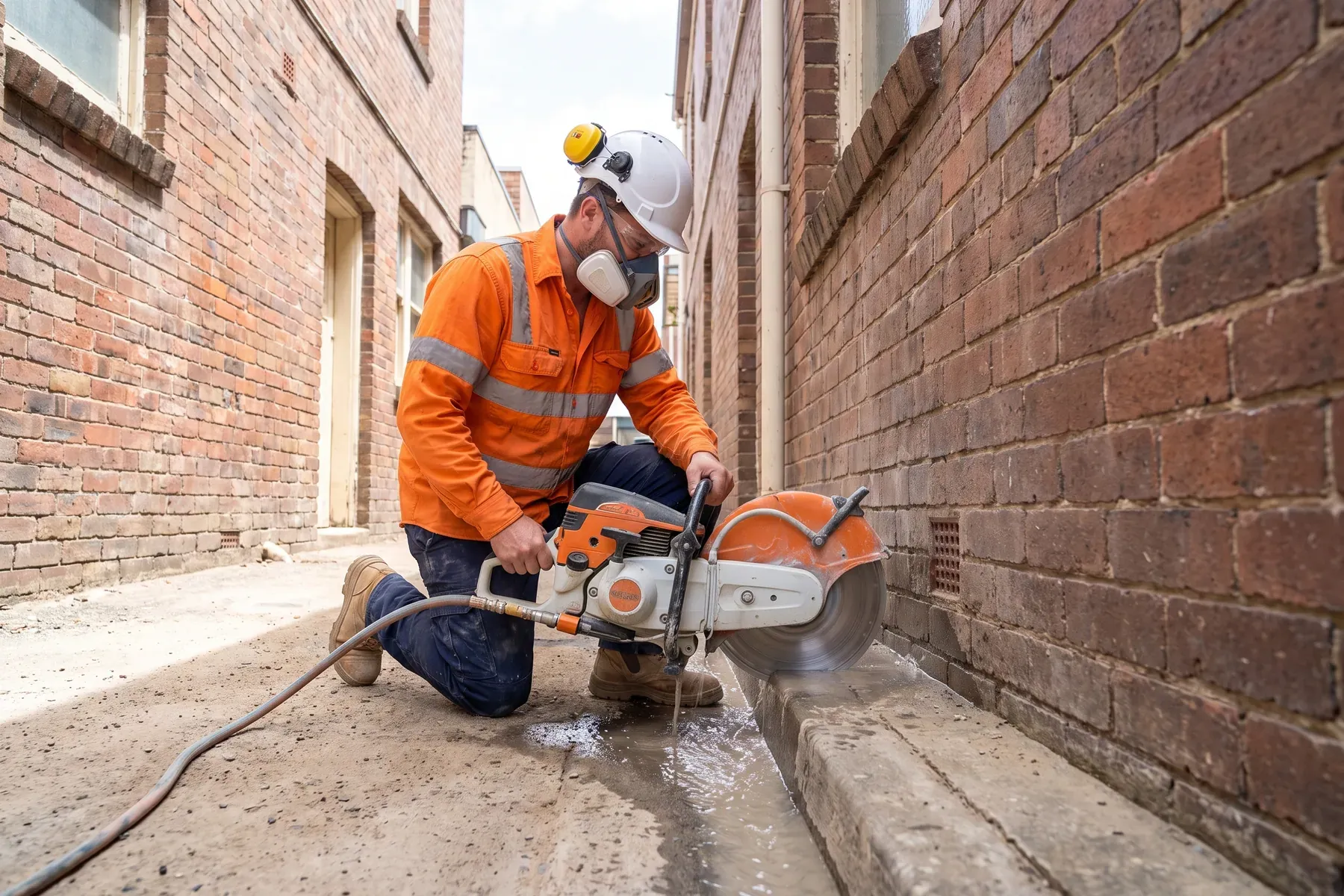
Cuts in places larger equipment cannot reach — inside buildings, along narrow side access, into corners, and where a machine cut has to be finished off square.
Have the access width, the cut length and depth, the surface orientation, and how much room there is to work.
- Chosen by constraint, not preference
- Depth is limited by the blade
- Often paired with another method
- Access
- Narrowest point on the route
- Cut
- Length and depth needed
- Space
- Room around the cut
- Area
- Occupied or clear
Two related methods, one decision
Hand sawing and ring sawing are grouped here because the decision behind them is the same one: larger equipment cannot reach the cut, or cannot finish it. Both are carried out by an operator holding the saw rather than by a machine running on wheels or a track, and both are limited by blade depth rather than by cut length.
The practical difference between them is reach. A ring saw drives its blade from the rim rather than the centre, which lets it cut deeper than a conventional handheld saw of the same size and plunge closer into a corner. Which of the two suits a job is settled on site, which is why they share one page rather than being split into two thin ones.
These methods frequently finish what another method starts. A floor saw leaves an uncut return at the end of every line, and a wall saw leaves the corners of an opening — both are completed by hand.
Does the access actually rule out a machine?
This pathway is chosen by constraint, not by preference. If a wheeled or tracked saw can reach the work, it will usually do a better and faster job. These are the conditions that mean it cannot.
| Condition | What it looks like | What to describe on the call |
|---|---|---|
| A machine cannot physically get there | Upstairs, through a house, inside a plant room, behind fixed equipment, or up a path too narrow to push a saw along. | The narrowest point on the route, and how many steps or level changes there are. |
| The cut finishes into a corner or an obstruction | A wheeled or tracked saw leaves an uncut return at the end of every line because of its blade radius. Something has to finish it. | Whether the cut has to meet a wall, a step or an existing edge squarely. |
| The cut is short but awkward | A few metres in a difficult position can take longer than a much longer cut in an open area. Setup, not length, is the driver. | How much room there is around the cut for someone to stand and work safely. |
| The required depth is modest | Handheld methods have a depth limit set by the blade. Deeper cuts either need a different method or cuts from both faces. | The depth required, and whether both faces of the element can be reached. |
| The area is occupied or sensitive | Smaller equipment can be set up and packed down quickly, which sometimes suits occupied areas better even when a machine would fit. | Who is nearby while the work happens, and whether hours are restricted. |
No particular saw, maximum depth or working position is promised from a description. The equipment for a job is selected and validated on site by the party performing the work.
What changes the job on site
On constrained jobs the surrounding conditions matter more than the cut itself, because setup dominates the work.
| What to check | Why it matters | Who supplies or confirms it | What to mention on the call |
|---|---|---|---|
| Concrete element and orientation | A slab, a wall, a beam and a suspended floor are different jobs even at the same dimensions. | You, from what is visible on site | What is being cut, and whether the surface is horizontal, vertical or overhead. |
| Approximate dimensions and depth | Lineal metres, hole diameter and cut depth are the first things that change the method and the time on site. | You, measured or paced out | Length or hole count, plus the thickness of the concrete if it is known. |
| Reinforcement | Mesh, bar and post-tensioned strand change how a cut is made and what has to be confirmed before it starts. | Drawings, the builder, or an engineer | Whether the element is reinforced, and whether any drawings exist. |
| Known services in or near the cut | Water, power, gas, comms, hydraulic and drainage lines have to be identified before a blade or bit goes in. | The site owner, builder or a service locator | What is known to run through the area, and whether anything has been marked or scanned. |
| Access and staging | Doorway widths, stairs, lifts, ramps and parking decide which equipment can physically reach the work. | You or the site contact | How equipment gets from the street to the work area, and where it can be set down. |
| Occupied areas and work windows | Noise, vibration and exclusion zones affect neighbours, tenants, staff and trading hours. | You, building management or the site contact | Who is nearby while the work happens, and whether hours are restricted. |
| Water supply and slurry control | Most diamond cutting is wet. Water has to get in and slurry has to be contained and removed. | You or the site contact | Whether there is a tap nearby, and where water may and may not run. |
| Dust and silica control | Cutting and drilling concrete releases respirable crystalline silica, which is a regulated exposure in Queensland. Wet suppression or on-tool extraction is standard, and enclosed areas need more. | The party performing the work, as part of its own job assessment | Whether the area is enclosed or occupied, and whether extraction or containment is required by the site. |
| Cut-out handling | A cut section still has weight. Lifting, breaking down and removing it may sit with a different party. | Agreed before work proceeds | Who is taking the removed section away, and whether it can be lifted by hand. |
Limits worth knowing before you call
What is not promised here
No specific saw, maximum cut depth, overhead working position, confined-space entry or dry-cutting method is promised from a description. Those are decided on site, by the party performing the work, as part of its own job-specific assessment.
Cutting concrete releases respirable crystalline silica, which is a regulated exposure in Queensland. Handheld work is the situation where that matters most, because the operator is closest to the cut. Water suppression or on-tool extraction is standard, and the controls for a particular job are set by whoever performs it.
Access width, cut length and depth, surface orientation, working room, and whether the area is occupied.
Ready the access details before you call
Nothing here is submitted or stored. Run through it so the first call covers what decides the job.
The job
- What is being cut — slab, wall, footing, path, block or brick
- What the finished opening has to be — a straight cut, a rectangular opening or a round hole
- Cut length in metres, or the number of holes and the diameter of each
- Cut depth, or the thickness of the concrete if it is known
- Whether the element is reinforced, and whether drawings exist
The site
- Suburb and postcode
- Property or site type — house, unit, commercial tenancy, managed building or active construction site
- Where the work sits within the property
- Whether the area is occupied while the work happens
- Any restriction on work hours
Access and services
- How equipment gets from the street to the work area
- Narrowest doorway, gate, path or lift on that route
- Where equipment can be set down and staged
- Whether a water tap and power are available nearby
- Any known services in or near the cut, and whether they have been marked
Responsibility and timing
- Whether a structural engineer has specified the opening or any support
- Who removes the cut section once it is free
- The site contact who can authorise the work and open the area
- Whether photographs of the area are available
- Preferred timing, described as a preference rather than a fixed date
Tight-access specifics
- Why larger equipment cannot reach the cut
- Narrowest doorway, gate, path or lift on the route
- Cut length and the depth required
- How much clear room there is around the cut
- Whether the cut has to finish square into a wall, step or existing edge
This checklist is information for your own use. It is not a form and nothing typed near it is collected by this website.
Tight-access questions
Is concrete sawing different from concrete cutting?
No — they describe the same work. Concrete sawing is simply the term used for the sawing methods within concrete cutting, and both cover floor, wall and handheld work.
What actually changes the job is the orientation of the surface, the geometry of the opening, the depth and the access.
Can the right method be decided over the phone?
A likely pathway can usually be identified from the description, but the final method is settled against the actual conditions on site.
Access, reinforcement, services and the surrounding area frequently change what is practical, which is why no method is confirmed as final from a phone description alone.
What should I have ready before I call?
The suburb, what is being cut, roughly how much, how deep, how equipment reaches the area, and anything known about services or approvals.
Photographs of the area help, and nothing needs to be exact — an approximate measurement described honestly is far more useful than a guess presented as a fact.
How is concrete dust controlled?
Cutting and drilling concrete can release respirable crystalline silica, which is why water suppression or on-tool extraction is used and why exposure is a regulated matter in Queensland.
The controls that apply to a specific job are decided by the party performing the work as part of its own job-specific risk assessment, not by a website.
Compare all four methods or read what to have ready before the call.
Sources used on this page
- Respirable crystalline silica in construction — WorkSafe Queensland (opens in a new tab)
Silica exposure controls when concrete is cut or drilled.
Describe the access
Why a machine cannot reach, how long and deep the cut is, and how much room there is to work are usually enough to establish whether the job is one to take further.
Access width, cut length and depth, and working room.