
Concrete Cutting or Core Drilling?
Straight cuts and rectangular openings behave differently from circular penetrations. Compare the two by opening shape, orientation, access, finish and the details each needs.
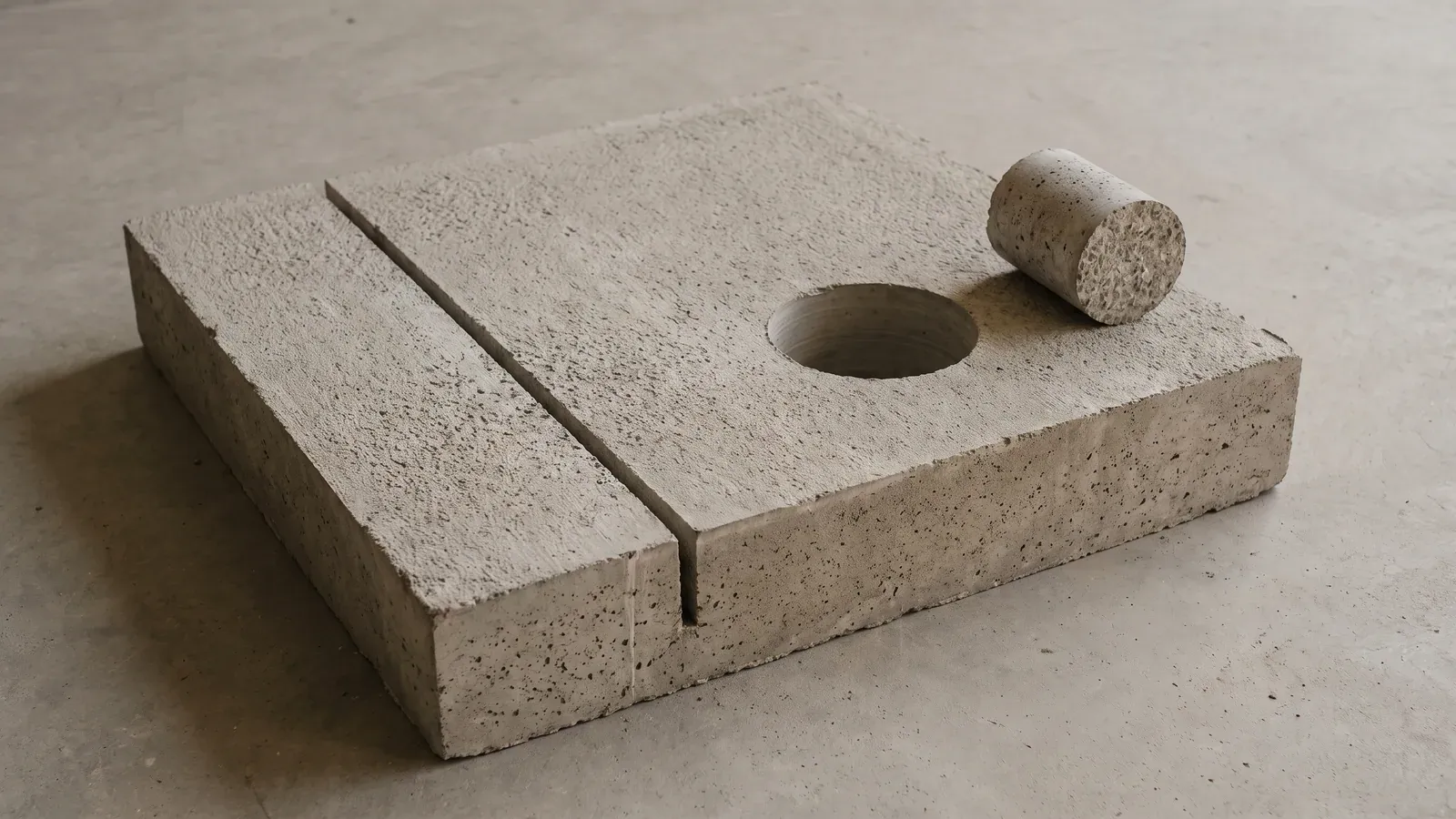
Short answer: if the opening is round, it is drilling. If it is a line or a rectangle, it is sawing. Both use diamond tooling on the same material, which is why the terms get used interchangeably — but they are different operations, described by different measurements, and they fail in different ways.
Getting the distinction right before the call saves a round trip, because the numbers you need to have ready are not the same.
The physical difference
A saw cuts a line. A blade spins on an axis and travels along the surface, separating one part of the concrete from another. The result is a kerf — a slot — and if you cut enough lines you can free a section entirely.
A core drill cuts a cylinder. A hollow diamond barrel rotates against the surface and advances into it, cutting an annular groove and leaving a solid core of concrete inside the barrel. That core is extracted whole, leaving a clean round hole of a known diameter.
That difference explains almost everything else. A saw is measured by how far it travels; a drill is measured by how wide it is and how far it goes in.
Compared side by side
| Attribute | Sawing | Core drilling |
|---|---|---|
| Opening shape | Straight lines, rectangles, freed sections | Circular penetrations |
| Measured by | Lineal metres and cut depth | Diameter, depth and hole count |
| Orientation | Horizontal for floor sawing; vertical or inclined for wall sawing | Down, horizontal or upward into a soffit |
| Typical use | Removing a section, forming an opening, trenching, isolating a slab area | Pipes, ducts, conduit, drainage, anchors and fixings |
| Finish at the corners | A blade cannot finish square into a corner — it leaves an uncut return | Every hole is complete in itself |
| What comes out | A section that has to be broken down and removed | A solid core, extracted whole |
| Access requirement | A run-up along the cut line, and room at each end | Room to anchor a rig on one face, and access to the exit point |
| Main limit | Blade radius sets the maximum depth per pass | Barrel length and rig setup room |
Which one your job needs
Ask what the finished opening has to look like.
Something has to pass through the concrete. A pipe, a duct, a cable bundle, a bolt. That is a hole, and the diameter is usually set by the product going through it. This is core drilling — see core drilling for the specification to bring.
A section has to come out. A piece of path, an area of slab, a panel from a wall. That is sawing: cut the perimeter and the section is freed. Horizontal work is floor sawing; vertical work is wall sawing.
An opening has to be formed in a wall. A doorway, a window, a large service opening. That is wall sawing — and if the wall is structural, the design and support questions come before the cutting question.
Nothing can physically reach the cut. Access, not geometry, is deciding. That points to hand and ring sawing.
Plenty of jobs need both
This is more common than the either/or framing suggests.
A rectangular opening in a wall is frequently started with a hole drilled at each corner. The reason is the blade radius: a circular blade cutting from the face cannot terminate square at a corner, so it either overcuts past the corner on the back face, or it stops short and leaves the corner uncut. Corner holes give the cut somewhere clean to finish into, and let the section be removed without overcutting into concrete that is staying.
Similarly, a slab opening cut with a floor saw leaves an uncut return at the end of every line for exactly the same reason. Something has to finish those — usually a handheld or ring saw.
So if you are asked whether the job needs drilling or cutting, “both” is often the accurate answer, and it is not a sign that anything has gone wrong.
What to have ready, for each
For a hole: how many, what diameter each one is (or what passes through it), how deep or how thick the element is, which way it runs, which face a rig can be anchored to, and what sits behind or below the exit point.
For a cut: total lineal metres across all lines, the depth required, the surface and material, whether the cuts are marked out, how equipment reaches the area, and who removes the section once it is freed.
Both share the same site questions: what the concrete element is, whether it is reinforced, whether anything is known to run through it, where water and slurry can go, and whether the area is occupied. Those are covered in what to prepare before calling.
What cannot be decided from a description
A likely pathway can be identified from a good description. The final method cannot be confirmed that way, because access, reinforcement, embedded services and the condition of the surrounding area routinely differ from what could be seen or described in advance.
Nothing here determines whether an element is safe to cut or drill. That is a structural question for an appropriately qualified engineer, and it has to be settled before an opening is planned rather than discovered afterwards.
Sources used on this page
- Respirable crystalline silica in construction — WorkSafe Queensland (opens in a new tab)
Silica exposure controls when concrete is cut or drilled.